The Blue Carbon Boom and the Path to Defining Property Rights
Recently, in response to China’s Dual Carbon policy (carbon peak and carbon neutrality), China’s first cross-border cooperation project for mangrove carbon sinks was signed in Jinwan, Zhuhai. Zooming out to Southeast Asia, a hotspot with the highest blue carbon storage, blue carbon transactions with European multinational corporations as buyers are also landing one after another. Global capital is accelerating its entry, paying for “ecosystem services.”
In fact, putting a price tag on nature’s ecological services is not achieved overnight; it has undergone a long cognitive evolution. As early as 2017, while pursuing a master’s degree in Japan, the author wrote an article for China Blue Sustainability Institute (a local NGO in Hainan), exploring Japan’s “Satoyama and Satoumi” model and the provisioning, regulating, and cultural services it provides. At that time, although China had already proposed the concept that “lucid waters and lush mountains are invaluable assets,” nature’s worth could mostly only be reflected through “policy advocacy” and “government financial subsidies” due to the lack of scientific quantification and economic stimulation for ecosystem value.
Today, as the Ecological Environment Code of the People’s Republic of China (hereinafter referred to as the Ecological Environment Code) is set to take effect on August 15 this year, “Green and Low-Carbon Development” has been compiled into an independent volume, elevating the Dual Carbon goals from policy guidance to a statutory mandates. More importantly, Article 693 of the new Code [1] lays a crucial legal foundation for the long journey of confirming ecological property rights. The breakthrough of the new Code lies in officially upgrading carbon sinks in mangroves and soil in rural areas from “public goods requiring subsidies” to legally protected, market-oriented “ecological assets”.
The law has finally granted the right to price ecological products, which is undoubtedly of positive significance for ecological protection. However, the flip side of the coin reveals a grim reality: when nature transforms from a “sentiment” into a “gold mine” flowing with real money, are the laws and institutions ready to protect the villagers who have guarded this gold mine for generations? If the underlying benefit-sharing mechanism is absent, the trading of statutory assets can easily degenerate into a legal “ecological grabbing” by powerful capital against vulnerable communities.
“Ground-Level Frictions” in Ecological Conservation
Undeniably, blue carbon trading has injected commercial vitality into marine ecological conservation (such as mangrove restoration), which has long lacked funding. Take Indonesia as an example: the Yagasu Foundation cooperates with coastal communities to restore mangroves, sells the carbon sinks to intermediary agencies, and channels the funds back to the communities. This creates a win-win positive cycle that increases fishers’ income while restoring the ecology.
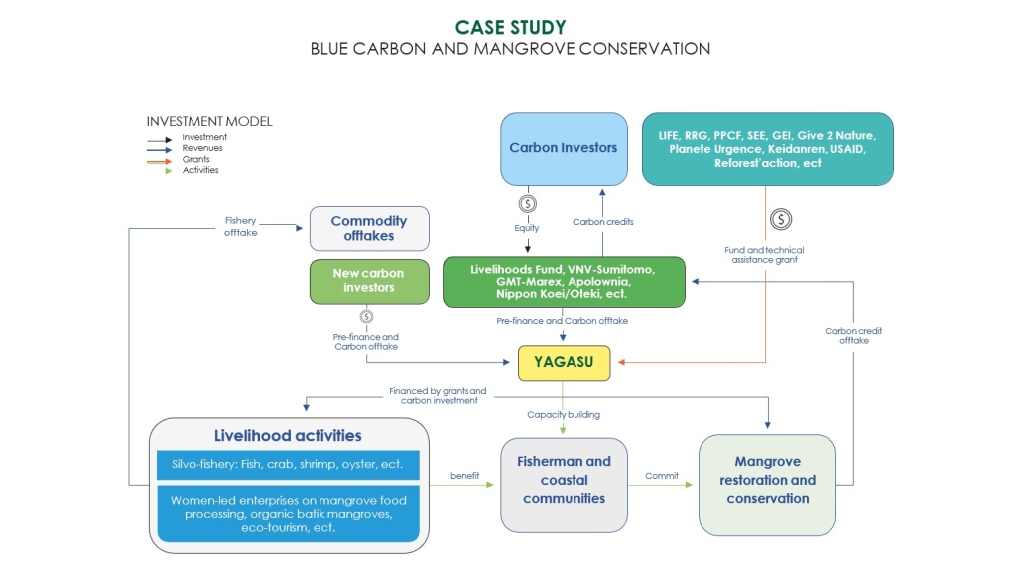
Yagasu Carbon Finance Model for Promoting Community Participation in Mangrove Restoration Projects. Source: Yagasu
However, stripping away the sentimental veil, hidden dangers in this model remain: Yagasu does not deeply intervene in the community’s internal distribution. How villagers are mobilized and how income is divided are entirely left to the village groups to decide autonomously.
In Thailand, the government-led Coastal Community Mangrove Carbon Credit program has triggered a more complex tug-of-war. Although most mangrove plots in Thailand belong to the state, local communities have traditionally held Customary Rights for gathering and utilization, and have even signed community co-management agreements with the government. Yet, this cooperation has encountered a deep trust crisis in the face of new “blue carbon” regulations.
Historically, the government had entrusted mangroves to enterprises for commercial logging, leading to villagers being banned from their livelihood operating areas for long periods. This unpleasant “historical memory” makes communities highly suspicious of new blue carbon agreements: they worry that once the mangroves are officially labeled as “carbon sink reserve areas,” even if the government currently adopts a voluntary and flexible attitude, will their future livelihood rights be deprived again by capital and administrative forces?
Under such doubts, local residents not only feel that the returns are meager (receiving only 20% of carbon revenues, plus some planting subsidies and maintenance fees), but also fear degenerating once again into unprotected “piece-rate tree planters.” As scholars like Christine Merk and others have pointed out, if the property rights of Blue Carbon Ecosystems (BCEs) are incompletely defined or lack the enforcement power to withstand policy fluctuations, payment schemes that only compensate for “carbon sequestration” often come at the expense of the community’s long-term trust and livelihood security.
Besides social concerns, there is also the risk of a “Carbon-Centric Metric” on the ecological level. To quickly generate carbon sinks, some projects plant single tree species on a large scale. The author has observed large areas of monoculture mangroves in Danzhou Bay, Hainan. Although it has not yet been designated as a blue carbon reserve area, this phenomenon of ignoring biodiversity in pursuit of specific metrics is not an isolated case in the industry.
The carbon storage value of a BCEs is merely the tip of the iceberg of its massive total ecosystem service value (such as windbreak and coastal protection, fishery breeding, etc.). Focusing solely on “carbon sequestration” tends to neglect other ecological services crucial to local communities, ultimately failing to achieve social optimum and instead triggering deep-seated conflicts.

Dense root systems of mangroves and the habitat they provide for wildlife. Source: Author
Why Does Exploitation Occur? Piercing the Illusion of “Community”
Why does a highly innovative mechanism generate such a strong sense of deprivation upon implementation? The core contradiction lies in: nature has been priced, but the fishers, as its “guardians,” have no pricing power. Compared to inland rural areas (like Tieniu Village in Chengdu) that directly monetize through ecological agricultural products, the capitalization process of marine blue carbon relies more on complex accounting and international trading, and its property rights are more ambiguous. This makes coastal communities more prone to falling into “aphasia” (loss of voice) under the dual pressure of capital profit-seeking and administrative law enforcement.
This “aphasia” gradually evolves into exploitation, not stemming from the malice of a specific individual, but as a structural result of extreme asymmetry in rights and resources during the dynamic bargaining among multiple stakeholders—government, capital, NGOs, and communities.
The underlying flaw supporting this unequal relationship is precisely the lack of rigid mechanisms to guarantee the voice of the vulnerable. When the powerful dictate the entire set of game rules, the community not only loses the opportunity to participate in decision-making but may even silently surrender their traditional living spaces.
During visits to multiple fishing communities in China and the Philippines last year, the author deeply felt the common dilemma of this “structural inequality” under different governance models.
Take Beigang Island in Haikou as an example. China tends to favor a top-down governance model. The villagers of Beigang Island once proudly stated that they voluntarily yielded parts of the sea area to plant mangroves for ecological protection and were willing to endure short-term profit losses from fishing and beachcombing. However, they soon fell into a “tragedy of the commons and property rights”: facing a massive influx of tourists endlessly beachcombing in the protected area, ecological protection appeared pale during the “last mile” of law enforcement. The volunteer patrol teams formed by villagers appeared even more powerless against the surging tide of beachcombers. This shows that even if both the government and the community have the will to protect, if law enforcement agencies lack effective enforcement measures, and the community lacks statutory management rights and a voice in enforcement, so-called ecological governance still faces a long and difficult road.
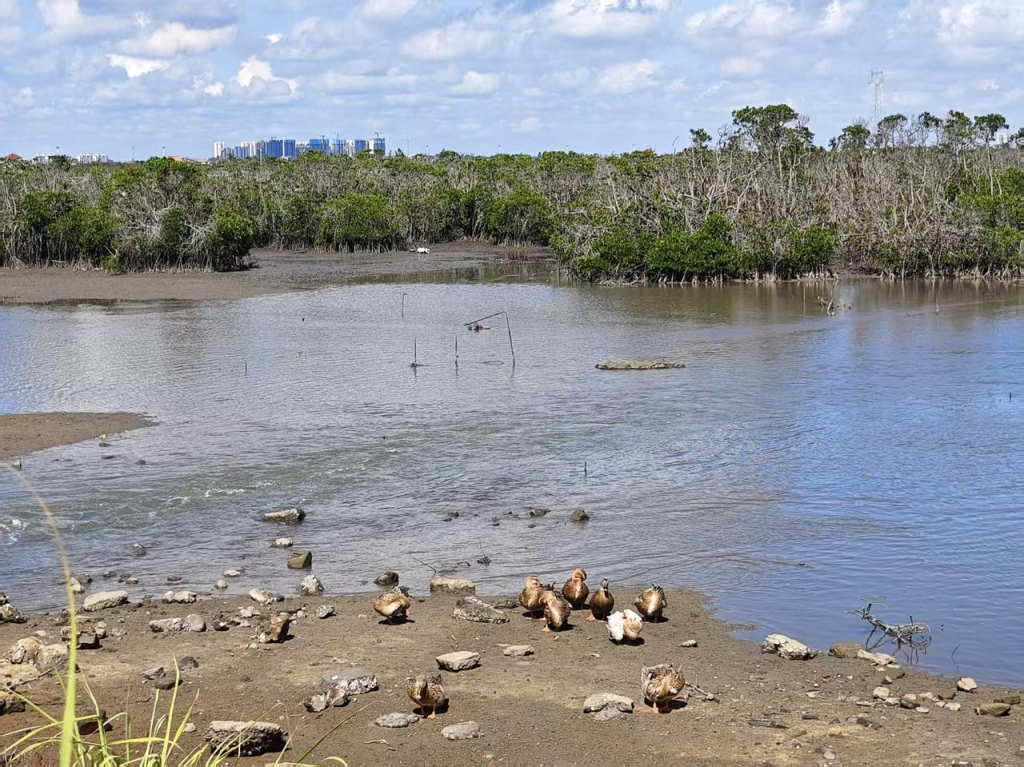
Mangroves and wild birds on Beigang Island. Source: Author
In some Southeast Asian countries, the aphasia of fishers presents a different face: this loss of voice originates from the systematic neglect of traditional rights at the inception of institutional design. In the advancement of many emerging marine projects, decision-makers often value capital entry efficiency over the livelihood security of indigenous people. Whether in the name of blue carbon or under the guise of building infrastructure like highways and dams, fishers are restricted to designated, narrow sea areas, helplessly watching their traditional living space (sea area use rights) being continuously encroached upon under the banner of “public interest.” The scarcity of compensation and the rupture of livelihoods mean that fishers, who once navigated freely on this sea, are collectively degenerating into marginalized labor under the logic of capital.
This cross-border common phenomenon forces us to dissect further: when we talk about safeguarding “community voice,” whose voice exactly are we talking about?
In long-term field observations, we must acknowledge a reality: a community is never a monolith; it is composed of different clan forces, interest groups, and specific individuals. Whether in China or Southeast Asia, those who represent the community to sign contracts and distribute money with the government or capital are often village heads, cooperative leaders, or village strongmen. Meanwhile, those who truly bear the ecological costs and lose their beachcombing mudflats are often the most marginalized, voiceless ordinary fishers, and even left-behind women.
Therefore, a genuine institutional design must not only prevent external capital from exploiting the community but also guard against “Elite Capture” within the community itself.
Breakthrough in Institutional Design: The Baseline Safety Net
Facing these gloomy realities, what kind of breakthrough do we need?
Laws and governance mechanisms are never perfect utopias; they cannot resolve all human weaknesses and implementation distortions in the “last mile,” but they must serve as an indispensable baseline safety net. Scholar Andrés M. Cisneros-Montemayor emphasizes that the emerging blue economy must rely on mandatory equity principles. Relying solely on voluntary Corporate Social Responsibility (CSR) is far from enough; mandatory government regulations must enter the arena. Otherwise, the profit-seeking inertia of “business-as-usual” capital will inevitably lead to the further marginalization of coastal communities.
When establishing payment schemes to support blue carbon development, local livelihood conditions, management structures, and benefit-sharing rules must be integrated into core considerations. And this institutional design to safeguard the right to speak must inherently be adapted to local conditions:
In Southeast Asia, facing the macro-dilemma of traditional rights being systematically ignored, the key to breaking the deadlock cannot remain merely at the patching up of individual projects, but requires advancing towards a deeper confirmation of rights. On the one hand, in specific blue carbon or development projects, there is an urgent need to push NGOs to help communities implement genuine “Free, Prior and Informed Consent (FPIC),” guide communities to understand complex legal terms, and ensure that the distribution of carbon revenues is secured via legally binding contracts (MOUs). On the other hand, from a long-term governance dimension, it is necessary to assist fishers in claiming and confirming “Customary Rights” over the traditional sea areas they have used for generations. Only when communities transform from “passive yielders without property rights” to “legally protected rights holders” can they truly break the capital inertia of “entry efficiency first”, secure an equal negotiating seat in the game of public interest, and build genuine trust with the government.
In China, we have ushered in an excellent opportunity for the rule of law. Relying on the upcoming Ecological Environment Code (e.g., Article 693’s confirmation of the path for transforming the value of ecological products) and the current Law on the Administration of the Use of Sea Areas regarding the transferability of sea area use rights, we should actively explore institutional innovations. For instance, drawing on the successful experience of forest right equity in the “Forest Ecological Bank” of Nanping, Fujian, we can fully utilize the legal entity status of “Rural Collective Economic Organizations” to explore allowing fishing villages to use “sea area use rights” or “ecological stewardship labor” as equity in blue carbon development projects. This model has already begun to emerge in the policy guidance of the National Development and Reform Commission and other departments, which encourage “sea area use rights to be priced as capital to participate in ecological restoration”. Only through fundamental design in the property rights structure can fishers truly transform from “tree-planting laborers” at the bottom of the capital chain into “blue carbon partners” sharing the dividends. Of course, down to complex grassroots realities, the “last mile” implementation still requires local governments, NGOs, and communities to pool their wisdom and break the language barrier between capital and rural society.
At the end of this article, I would like to borrow a passage from Mr. Fei Xiaotong’s Peasant Life in China as a conclusion. Although he was speaking about the land of inland villages, we can extend its meaning to coastal communities and sea areas:
“‘If one knows nothing about the game itself, one cannot understand the rules of the game.’ … You must first know how humanity uses its land; how folklore, beliefs, and mystical values fluctuate around the land issue; how people fight for the land and defend it; after understanding all this, you can comprehend the system of legal and customary rights that defines the relationship between humans and the land.”
Nature has been priced, and the “game” has begun. Before rushing to write the grand narrative of carbon neutrality, please bend down and listen to the concrete and faint sound of the tide on that mudflat.

Footnotes:
[1] Article 693: The State shall establish a mechanism for the investigation and monitoring of ecological products, and explore the determination of the ownership of rights and responsibilities for ecological products by carrying out unified registration of natural resource property rights. The State shall establish a value evaluation mechanism for ecological products, improve the value accounting methods, and promote the effective transformation of the value of ecological products. The State shall improve the sustainable realization path of ecological product value featuring government guidance, participation by enterprises and all sectors of society, and market-oriented operations; complete the operation and development mechanism for ecological products; and expand channels for realizing the value of ecological products in a manner suited to local conditions, on the premise of strict protection of the ecological environment.
References:
- Southern Metropolis Daily. (2026, March 29). The nation’s first! Cross-border development project for mangrove carbon sinks lands in Jinwan, Zhuhai. 21jingji.com. https://www.21jingji.com/article/20260329/herald/76ba7f440e979ed158347181faaca49e.html
- Haiyu. (2017, March 21). We will protect the “Satoyama and Satoumi” in Hayao Miyazaki’s animations! WeChat Public Platform (China Blue Sustainability Institute). https://mp.weixin.qq.com/s/pJkrgBQcS5e1d0DwN1mdww
- China Blue Sustainability Institute. (2024, July 25). Re-appreciating a good article: Is the income from carbon sinks enough to restore mangroves? WeChat Public Platform (Blue Climate Initiative). https://mp.weixin.qq.com/s/AjOd3e957pr8beueqzrS_g
- Qiao, Feng. (2026, January 9). Blue carbon trading advances mangrove restoration—Thailand’s progress and challenges. WeChat Public Platform (Blue Climate Initiative). https://mp.weixin.qq.com/s/DvJUxRvHpg-5w9283Gb9NQ
- Singapore Economic Development Board. (2026, January 12). Unlocking Southeast Asia’s blue carbon potential through advanced technologies. https://www.edb.gov.sg/en/business-insights/insights/unlocking-southeast-asias-blue-carbon-potential-through-advanced-technologies.html
- Cisneros-Montemayor, A. M., Ducros, A. K., Bennett, N. J., Fusco, L. M., Hessing-Lewis, M., Singh, G. G., & Klain, S. C. (2022). Agreements and benefits in emerging ocean sectors: Are we moving towards an equitable Blue Economy?. Ocean & Coastal Management, 220, Article 106097. https://doi.org/10.1016/j.ocecoaman.2022.106097
- Merk, C., Grunau, J., Riekhof, M.-C., & Rickels, W. (2022). The need for local governance of global commons: The example of blue carbon ecosystems. Ecological Economics, 201, Article 107581. https://doi.org/10.1016/j.ecolecon.2022.107581
- FAO. (2015). Voluntary Guidelines for Securing Sustainable Small-Scale Fisheries in the Context of Food Security and Poverty Eradication. Food and Agriculture Organization of the United Nations. https://www.fao.org/3/i4356en/I4356EN.pdf
- Bennett, N. J., Govan, H., & Satterfield, T. (2015). Ocean grabbing. Marine Policy, 57, 61-68. https://doi.org/10.1016/j.marpol.2015.03.026
- Vierros, M. (2017). Communities and blue carbon: the role of traditional management systems in providing benefits for carbon storage, biodiversity conservation and livelihoods. Climatic Change, 140(1), 89-100. https://doi.org/10.1007/s10584-013-0920-3
Disclaimer: The field materials concerning Southeast Asia and Beigang Island, Haikou, presented in this article are derived from publications by the Blue Climate Partnership (BCP) and related projects the author participated in during her previous tenure at BCP. The author expresses gratitude to the BCP team for their support in the relevant research. The views and opinions expressed in this article are strictly those of the author from a personal professional perspective and do not necessarily reflect the official policy or position of the organization.
Copyright Notice: This article is an original work by Shining. For reprint authorization, please leave a message or contact [email protected].